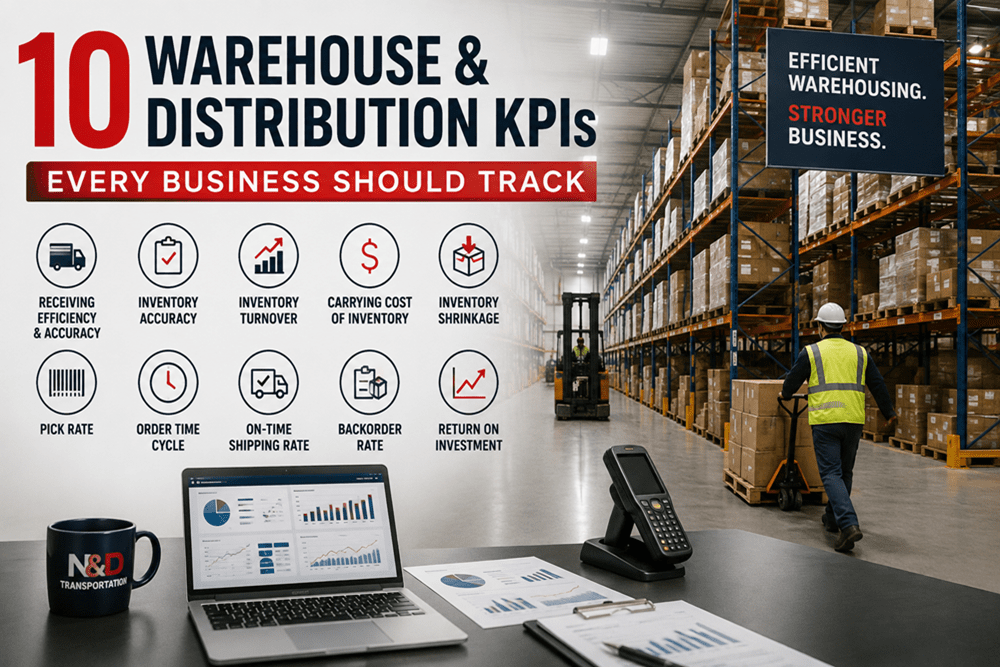
Whether your business is just moving out of your garage or you’ve been operating independently for years, the right warehousing partner can help you up your productivity and keep your clients satisfied. Warehouse KPIs (key performance indicators) are vital to improving efficiency and hitting deadlines.
In this blog, we’ll show you examples of warehouse kpis that track overall warehouse performance and efficiency, and how to know if your warehousing partner is meeting the mark.
What Are Warehouse KPIs?
Warehouse Key Performance Indicators (KPIs) are a way of tracking how well your warehousing partner meets your goals for important measures like efficiency, accuracy, and overall productivity. Like any other KPI in your business, they help you understand how the warehouse does its job, and the benefits that it passes on to your company’s shipping and distribution.
Why Should You Track Warehousing Metrics as A Small Business?
If you’re working with a third-party warehouse rather than operating your own, tracking internal warehousing metrics and KPIs might feel like overkill. But requesting metrics from your contacts at the warehouse helps you understand exactly how much your business has improved by working together – and shows you where there’s room for improvement.
10 Warehouse KPIs for Small to Medium-Sized Businesses

Receiving Efficiency & Accuracy
This warehouse efficiency metric tracks how efficiently incoming shipments are received and logged. When a warehouse receives a new shipment, they’re immediately scanned into the warehouse management system and stored in its internal data.
On the warehousing side, this KPI helps the operator understand how well their offloading process works, and if there are any points where the standard operating procedure or workers could operate more efficiently.
Inventory Accuracy Is A Vital Warehouse KPI
Measures how closely the internal WMS data matches the actual physical stock in storage. This warehouse KPI is crucial for accuracy, since it helps inform your other inventory-based KPIs.
Any internal system is bound to have a small margin of error, but a reputable warehouse should have inventory accuracy above 95%.
Inventory Turnover Keeps Warehouse KPIs On The Mark
This metric measures how often you sell and replace your inventory within a given time period, such as within a month or year.
A high turnover indicates that you have high demand and can move stock well, although a turnover that’s too high can also place you at risk of selling out.
Carrying Cost of Inventory
This warehouse KPI is closely tied to inventory turnover. It measures the overall cost of holding inventory over a given time period. It’s considered healthy for this metric to run between 15 and 30% of your inventory’s total value.
If the percentage is higher, it can indicate that you’re spending too much on holding inventory that doesn’t meet consumer demand.
Inventory Shrinkage
These warehouse performance metrics measure how much inventory you lose over a given time period. While you obviously want as much stock as possible to make it to the customer or manufacturer, some inventory may be lost to issues like shipping damage, clerical errors, shortages, or theft.
Ideally, inventory shrinkage should be 1% or less. Any higher can indicate a problem either with your supply chain or the warehouse’s internal operations.
Pick Rate Warehouse KPIs
The pick rate measures how many orders the staff can retrieve per hour. This is one of the most important KPIs for distribution centers and shows you that the warehouse is working efficiently to meet demand and ship your orders without delays.
A good manual pick rate is typically between 60 and 100 per hour, while automated systems can range much higher. Although, that can depend on the industry and your type of products.
Order Time Cycle
This metric measures the total time from when an order is placed to when it’s handed off to a shipping carrier or direct distributor. It’s calculated by dividing the total fulfilment time at a warehouse by the total number of orders shipped.
The standard benchmark for an order time cycle is typically 24 to 72 hours, but different industries may have longer or shorter target windows.
On-Time Shipping Rate
This KPI tracks the percentage of orders that are able to meet the promised shipping date for customers. A strong on-time rate indicates that your warehouse or distribution center is operating efficiently and able to keep up with the demands of your business.
Ideally, the on-time rate should be above 95%. If the rate dips lower than that, other warehousing KPIs or supply chain issues might be at play, like low stock or a poor picking rate.
Backorder Rate
The backorder rate measures the number of customer or client orders that aren’t able to be fulfilled due to low inventory. Ideally, this rate should be as close to zero as possible. An uptick in backorders can indicate problems with supply and demand, particularly with understocking popular inventory.
Return on Investment
An important warehousing KPI you’re no doubt already familiar with, the return on investment (ROI) shows in exact numbers how much working with a third-party logistics provider helps you increase productivity by keeping up with higher demand, reducing overhead costs and time-crunches, and increasing your shipping efficiency.
A good target ROI depends on the cumulative value of your investment – and the hidden value you get by taking the tasks off your own plate.
A Rhode Island Warehouse to Maximize Your Warehouse KPIs
If you need to partner with a New England warehouse who can help you meet all your targeted warehouse KPIs and performance metrics, N&D Transportation is here to help.
Our Rhode Island distribution center prides itself on being one of the most efficient in the New England area, and we put our all into turning our warehouse efficiency KPIs into strong outcomes for our clients. Contact us today to meet your distribution goals together.