
Between tariffs on China, ocean trade route disruptions, and more global supply chain uncertainties, more American businesses than ever are taking a closer look at their manufacturing processes. Some are bringing their manufacturing operations closer to their home base by nearshoring, with an AXIOS survey showing that nearly half of US businesses took nearshoring action in 2023 alone.
Below, learn all about what nearshoring is, why it’s a trending logistics strategy, and how working with a third-party logistics company can help you make the transition.
What Is Nearshore Outsourcing?
Nearshoring is a supply chain strategy that shifts manufacturing from offshore facilities to ones closer to your home country. For example, if you’re based in the United States, popular nearshore manufacturing destinations are Mexico, South and Central America, and Canada.
Why Nearshoring Is Growing: Key Trends
COVID-19 showed businesses across the globe how truly fragile their supply chains can be.
Other recent supply chain incidents, like the blockage of the Suez Canal, rerouting in the Black Sea, and the blockade of the Strait of Hormuz are stark reminders of how geopolitical tensions and blocked trade routes can bring imports to a screeching halt.
After the pandemic, a survey found 92% of manufacturing executives considered nearshoring, with around one third making the decision to nearshore within three years. Beyond greater stability in the global supply chain, nearshoring can also enable manufacturers to realize savings on overseas trips and shorter shipping times.
Nearshoring vs Offshoring vs Reshoring: What’s The Difference?
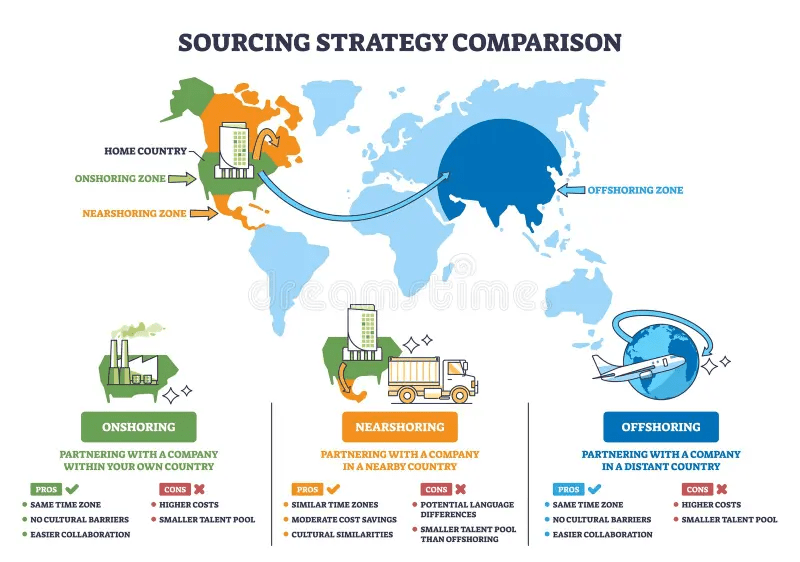
Nearshoring, offshoring, and reshoring all involve moving the base country of your business’s manufacturing partner. The main difference lies in the new destination country.
Offshoring
Offshore manufacturing involves moving your company’s manufacturing operations from your home country to one with lower material and labor costs or a more efficient workflow.
China has traditionally been the most popular offshore manufacturing location, but Vietnam, India, Thailand, and Malaysia are other alternatives.
Nearshoring
Nearshoring is also a type of offshoring that involves bringing your manufacturing closer to home, often within the same continent or time zone.
For example, if you’re based in the UK, you might shift manufacturing from an Asian country to one in Europe, like Poland or Romania. For US nearshoring, Mexico is the top destination, with tax benefits and a shared land border that cuts out ocean shipping entirely.
Reshoring
Reshoring is similar to nearshoring. But instead of shifting manufacturing to a closer country, it brings it back within your home country. Reshoring is also becoming a more popular alternative to traditional offshoring, with 2024 data showing that around 69% of US companies had started reshoring initiatives in some capacity.
What Are The Benefits of Nearshoring for Your Supply Chain?
Beyond enjoying greater stability from geopolitical conflicts, switching to nearshoring could also give your supply chain the following benefits.
Nearshoring provides shorter shipping times
Choosing a nearshoring partner on the same continent can allow you to potentially cut weeks off your import times.
For example, instead of waiting weeks or months for a shipment to travel the oceans, a truck can make it from Mexico to the US within a matter of days, depending on the proximity of the factory to the border. You also don’t need to worry about delays from port congestion or overseas blockages.
Tax advantages
Some nearshore companies offer tax advantages to incentivize US companies. For example, Mexico’s IMMEX program waives the country’s usual 16% import tax on raw materials when a foreign company owns and operates a factory in Mexico.
Other Cost Savings
Shorter overall shipping distances mean you won’t need to pay as much per mile for shipping, even if you do choose a nearshoring partner that requires ocean transport.
For North American partners with shipping by rail or truck, you also don’t need to worry about cost fluctuations of shipping containers or other variables that impact ocean freight.
Better Oversight
If you’re concerned about quality control or safety practices in your factory, nearshoring makes it much easier to supervise operations. For factories in Canada or Mexico, you can drive across the border from the US, rather than sitting on a 12-24-hour flight.
Lower Language Barriers
Choosing a nearshore partner country like Mexico could reduce the language barrier for many people in the US. Around 10% of Mexicans speak English, and Spanish is the most popular non-English language in the United States.
The overlap can allow for easier communication between company owners and factory managers. The closer time zones also means you could get answers faster, rather than waiting 10 to 12 hours for the day to start.
Challenges and Drawbacks of Nearshoring
Of course, nearshoring isn’t entirely without its drawbacks. While nearshoring is still cheaper than reshoring, the base costs of manufacturing often still aren’t as cheap as those in offshore partners located in Asia.
Reconfiguring your manufacturing process also means vetting new factories, learning new processes, and adopting entirely new importing protocols for your business. It’s a lot to adjust to, especially on your own.
How Third-Party Logistics Partners Support Nearshoring Success
Fortunately, working with a third-party logistics company (3pl) can make the transition into nearshoring much easier and more streamlined.
Some of the benefits of choosing a 3pl for nearshoring include:
- Managing cross-border compliance: Your 3pl can handle border inspections and passing customs on time.
- Strategic warehouse locations: Many 3pls have their own distribution warehouses near key roadways, which makes importing easier and allows you to store your products or materials closer to your home base.
- Scalability: A 3pl partner can scale up or down with your company’s needs. If you want to shift partially into nearshoring before making the full leap, your 3pl can help you meet your company’s needs where they’re at.
Trust A Rhode Island Transportation Company for Your Supply Chain
If you want to work with a Rhode Island logistics company who can partner with your business for nearshoring success, N&D Transportation is here for you.
From our base in North Smithfield, Rhode Island, we handle direct distribution throughout New England and offer brokerage services internationally. We’ll work hard to make the change into a new manufacturing partner as seamless as possible, and find every opportunity to make your import process more cost-friendly and efficient.
Contact us today to learn more about how we can help your business improve your nearshoring supply chain.